
Ed Tech Design Collective Spotlight
OKO Labs

OKO is an AI-powered small-group math instruction and intervention platform for grades 3–12, in use across charter networks and public school districts nationally. OKO facilitates small groups of two to five students working on academic content, nudging their discourse rather than tutoring them one-to-one, and gives teachers a read on both the mathematics and the collaboration in every group.
Built around active student engagement, kids talk out loud to each other while the AI acts as a facilitator. Students receive real-time feedback and develop durable skills—collaborating, communicating, and defending their reasoning—without standard one-to-one screen time or chatbot interactions. Meanwhile, teachers stay fully in the loop, able to pull their own small groups that need them most or freely circulate the room.
What should educators know about OKO Labs?
Most edtech right now is building the same thing: one student, one screen, an AI tutor pulling them into a private conversation. That works for the small share of highly motivated learners and leaves everyone else behind. What teachers actually ask for is an extra set of hands to run small groups.
OKO is that. Students work in groups of two to five on content matched to teachers’ scope and sequence. OKO listens to the conversation, nudges reasoning without handing over answers, and afterward gives the teacher a read on every group: the math and the collaboration. The teacher stays the teacher and can finally be at more than one table.
OKO Labs is in charter networks and public districts, they have a peer-reviewed study and an independent WestEd randomized controlled trial behind them, and their whole bet is that the right way to use AI in school is to bring kids together rather than keep them apart.
What sets OKO Labs apart?
What sets OKO apart in the K–12 education innovation space is its pro-social, facilitator-first approach to AI and its dedicated focus on collaborative small-group instruction. Where most edtech solutions isolate students behind one-to-one screens or direct-to-student chatbots, OKO reimagines AI as a quiet classroom co-pilot that drives human connection, deeper reasoning, and actionable teacher insights. Key differentiators include:
Pro-Social AI Facilitator (Not a Chatbot): OKO acts as an "extra set of hands" in the classroom. Instead of providing individual one-to-one tutoring or giving away direct answers, OKO’s AI operates as a quiet background facilitator that prompts students to speak to each other, listen actively, and build consensus.
Durable Skills & Discourse Quality: Grounded in learning science, OKO moves beyond rote practice or superficial guessing. Through a real-time system of "look-fors" and targeted "nudges," OKO explicitly coaches durable skills—teaching students how to collaborate, communicate, critique, and defend their mathematical reasoning out loud.
Teacher Empowerment & Visibility: Group work is traditionally a "black box" where teachers cannot observe every interaction. OKO opens that box by providing real-time and post-session insights on both student math performance and group collaboration dynamics, allowing educators to pull target small groups or circulate the room effectively.
Privacy-First & Student-Centered Design: Students never engage in private, isolated one-to-one AI conversations. All student data is de-identified before reaching any AI models, ensuring strict data privacy while keeping human-to-human interaction at the center of the experience. Independently validated: ESSA Tier III & IV certified. OKO fully supports FERPA and COPPA and exceeds state security and privacy guidelines.
How does OKO Labs support educators and center learners?
OKO supports educators in creating student-centered learning experiences by turning the traditional "black box" of small-group work into an active, visible, and equitable environment where students drive their own learning. The platform creates student-centered environments across two key dimensions:
Building Student Agency & Durable Skills: OKO fosters a supportive space for productive struggle, empowering students to take ownership of their mathematical thinking. By rewarding active listening, productive disagreement, and collaborative problem-solving, OKO helps students develop essential 21st-century skills—communication, collaboration, and critical thinking—while measurably reducing math anxiety.
Expanding Teacher Reach & Decision-Making: In a typical classroom, a teacher cannot monitor every small group simultaneously. OKO acts as an extra pair of hands, freeing teachers from basic group management so they can either target the small groups that need them most or circulate the room effectively. Furthermore, OKO unlocks group dynamics by delivering live and post-session insights to the educator dashboard. Teachers gain immediate visibility into individual conceptual understanding, mathematical reasoning, and collaboration scores, enabling precise, data-driven differentiation.
AI-Facilitated Discourse Ignites Engagement and Improves Outcomes
Case Studies of OKO Labs in the Field
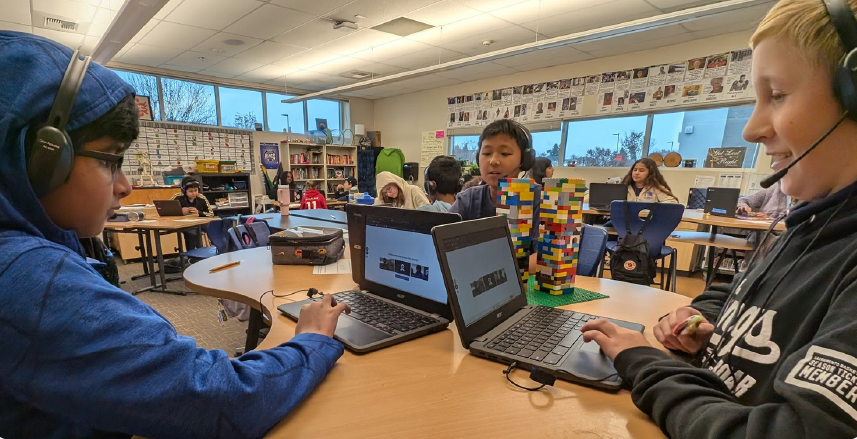
Two case studies from OKO Labs demonstrate improvements in the learning experience and learning outcomes through small group discourse aided by the OKO platform.
At The Kindezi Schools in Atlanta, Georgia, fourth-grade students’ geometry scores grew from 31 percent to 87.5 percent from mid-year to the end of year with approximately 30 minutes of OKO implementation per week.
“OKO was a game changer—it helped students talk through math together, even when I couldn’t be with every group.”
Westlake Charter School in Sacramento, California, observed declining math engagement, limited participation in math-related discourse, and challenges sustaining high-quality discussion among small groups in Sally Hubbard’s sixth-grade class. Hubbard added OKO to brief, targeted rotations during class, approx. 10 minutes a session. Over time, students began using math language more naturally and confidently, they engaged in math discourse more willingly, accepted struggle and mistakes as part of learning, and improved peer collaboration.
Explore more edtech solutions and tools in the LEAP EdTech Directory.